From polycrisis to polysolution.

IP3 turns complex development challenges into evidence, policy, and practical action.

Independent policy analysis, action research and management consulting for governments, development partners, multilateral development banks, universities, think tanks and private-sector institutions.

Or go straight to our 8 sectors and 6 capabilities.

Scroll

Every hard public problem is several problems at once.

A fiscal squeeze shows up in schools. A heatwave shows up in the power grid. A weak institution turns a good budget into a stalled project.

The first job is to see how these pressures connect. Select a system to see what it is tied to.

Start with what can be checked.

We build the evidence base from five kinds of material and keep each one traceable to its source.

Layering them lets us test one against another, so a finding does not rest on a single number or a single interview.

Patterns become findings when they survive scrutiny.

Two questions come up in almost every engagement: did it work, and is it worth it? These diagrams show how we frame each one.

Did it work?

Outcome indicator (illustrative scale) Programme starts Baseline Endline Time Comparison group Supported group Without theprogramme(estimate) Estimatedimpact
We compare change in the supported group with change in a similar group that was not supported. The gap beyond the dashed line is the estimated effect of the programme.Illustrative example of the method, not project data.

Is it worth it?

Costs Benefits Cumulative net benefit 0 Value (illustrative units) StartLater years Time since the project starts Break-even
Costs come early and benefits build over time. The point where cumulative net benefit turns positive shows when the investment pays back. A full analysis also discounts future values and tests how the result changes under different assumptions.Illustrative example of the method, not project data.

Findings become choices.

Evidence rarely points to a single answer. We set out the options, what each costs and risks, who has to act, and what implementation will take, so the decision is made with open eyes.

Worked example, hypothetical: a ministry must widen access to secondary school on a fixed budget.

  1. Findings

    Where children are missing out, and the reasons behind it.

  2. Options

    Three routes compared on the same terms.

    • Expand existing schools
    • Fund transport and stipends
    • Build new schools where demand is growing
  3. Trade-offs

    Each option tested for what it costs, who benefits, how fast it works and how likely it is to succeed.

    • Fiscal cost
    • Equity
    • Speed
    • Feasibility
  4. Implementation choices

    Who delivers, how it is financed, which rules must change and how results will be tracked.

  5. Institutional decision

    A recommended option, the conditions attached to it and the indicators to watch after launch.

A decision only matters once it reaches a service.

Policy moves through ministries, agencies and municipalities into budgets, rules and front-line services. We help design the delivery arrangements, skills and monitoring that let a change hold.

  1. Institutions

    Mandates, structures and procedures are set so the right body owns the change.

  2. Programmes

    Budgets, eligibility rules and delivery plans turn a policy into something a team can run.

  3. Services

    Schools, clinics, utilities and municipal offices receive the skills, tools and guidance to deliver.

  4. Communities

    Households and firms are reached, and their experience is fed back to decision-makers.

Public value is something you can check later.

We agree how success will be recognised before the work starts, so results can be tracked, learned from and reported honestly.

  • Stronger institutions

    Clear mandates, budgets that are spent as planned, and decisions that can be traced to evidence.

    How it can be shownBudget execution, procurement and planning records, audit findings.

  • Better services

    Services that reach more of the people entitled to them and work when they arrive.

    How it can be shownCoverage and quality measures from administrative data and user surveys.

  • More resilient systems

    Public finances, infrastructure and programmes that absorb shocks instead of breaking under them.

    How it can be shownStress tests, risk registers and performance through disruptions.

  • Improved lives

    Households with better health, learning, income and security than they would otherwise have had.

    How it can be shownEvaluation designs that compare outcomes against a credible counterfactual.

IP3 in motion

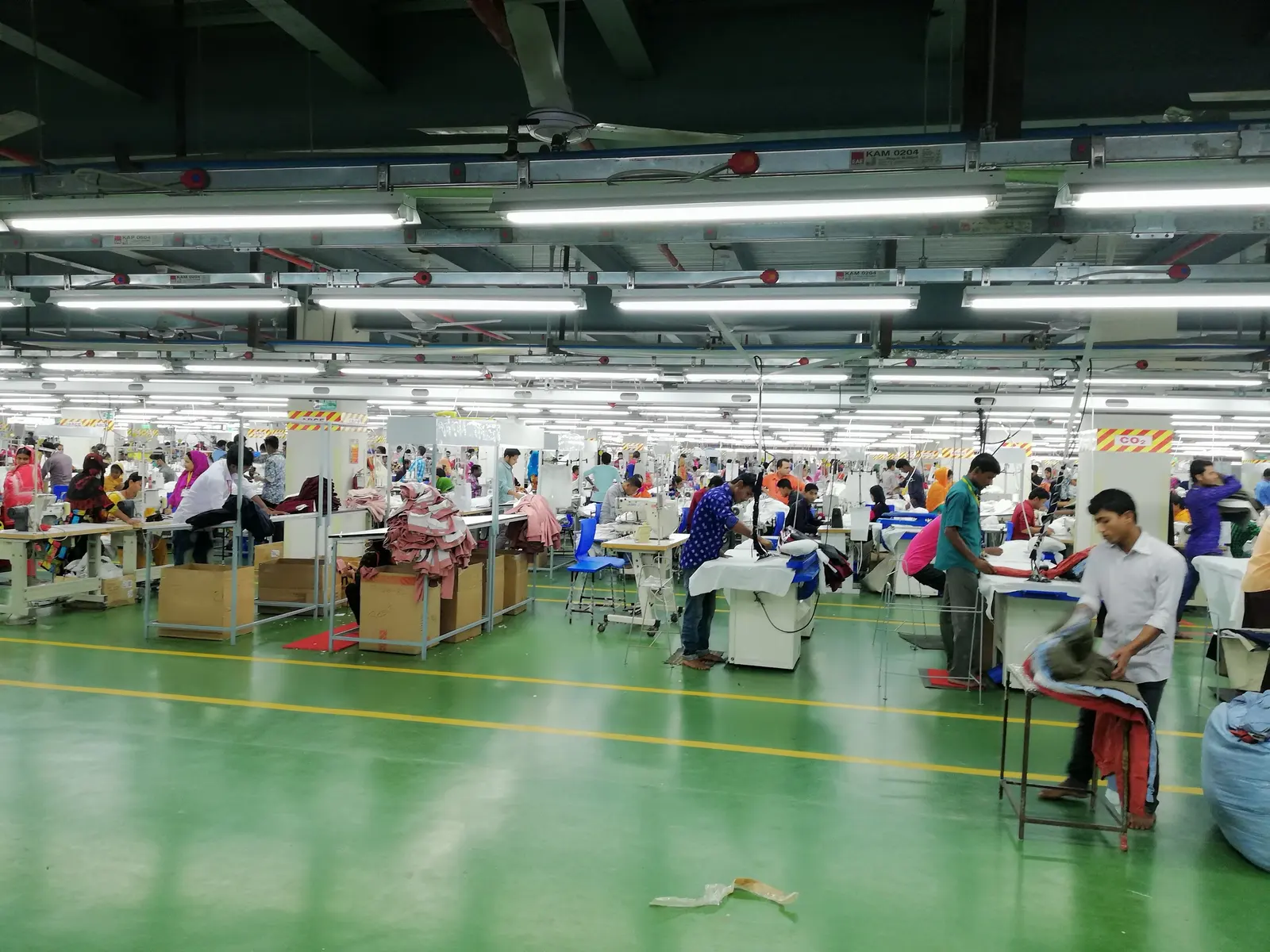
From the factory floor to the data room.

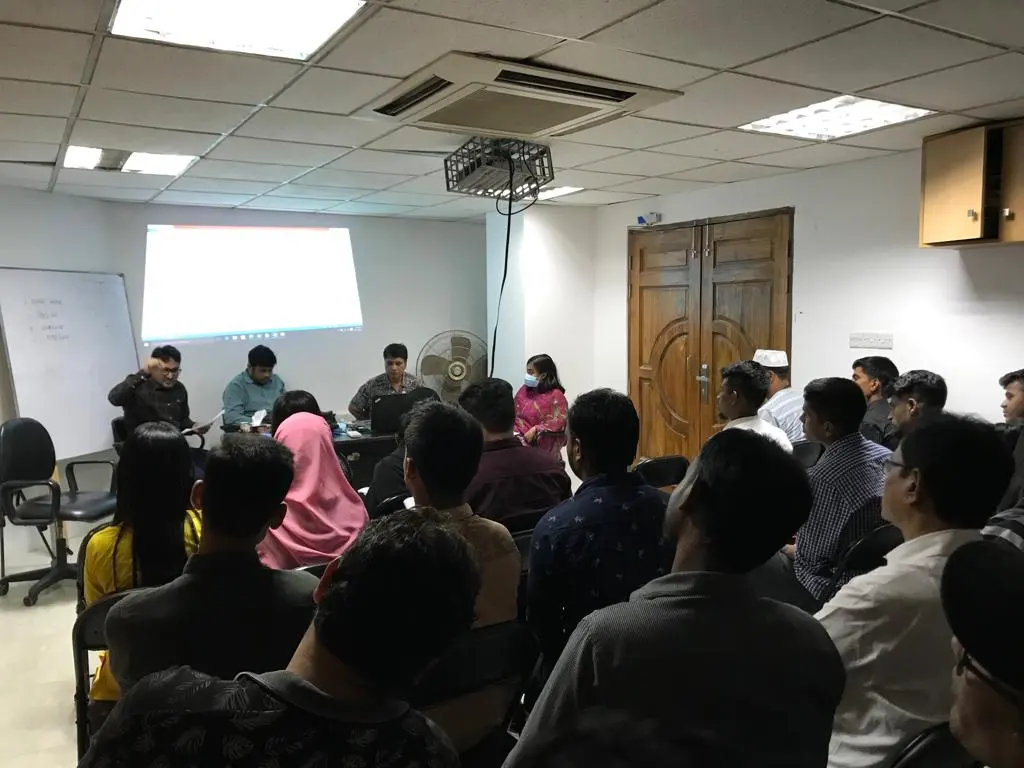
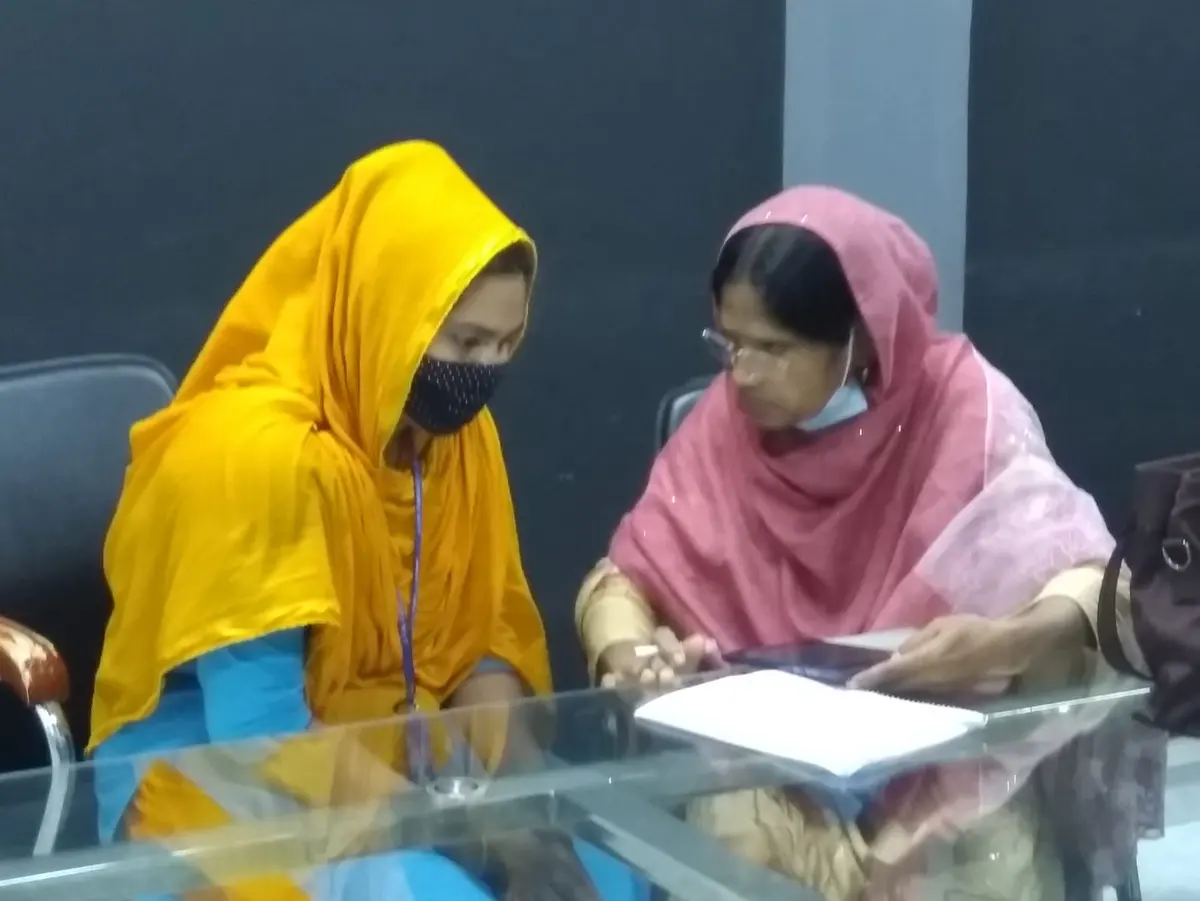
Thirty seconds on how we work: start with the system, test what can be checked, and stay until policy works on the ground.

Capabilities

What clients hire IP3 to deliver.

Six kinds of help, each written as the problem a client brings to us.

01Policy, Economics & Strategy Advisory
“We need to understand the problem and choose a defensible course of action.”
DiagnosticsModelingPolitical-economy analysisRegulatory reviewsSector strategiesFiscal and cost-benefit analysisReform road maps

Climate · Education · Health Systems · Governance · Economic Transformation · Sustainable Finance · AI

Policy & Economics
02Program & Project Design
“We have a mandate or funding window but need an implementable program.”
Feasibility studiesTheories of changeConceptsResults frameworksImplementation and financing plansRisk registersProject-preparation support

Climate · Education · Health Systems · Digital Government · Economic Transformation · Sustainable Finance · AI

Program Design
03Development Finance & Private Capital Mobilization
“Public funding is insufficient; how do we make this investable?”
Investment casesBlended-finance strategyPPP advisoryFinancial modelsBankability assessmentsClimate-finance strategyPipelinesMarket soundingDe-risking

Climate · Governance · Economic Transformation · Sustainable Finance

Development Finance
04Institutions, Governance & Delivery
“A policy exists, but institutions cannot implement it consistently.”
Institutional diagnosticsGovernance frameworksPFM reformDelivery modelsProcess redesignCapacity developmentChange management

Health Systems · Digital Government · Governance · AI

Institutions
05Monitoring, Evaluation, Learning & Impact
“We need to know what is working, why, for whom, and whether it can scale.”
MEL frameworksBaselinesProcess and impact evaluationsLearning agendasOutcome harvestingDashboardsAdaptive management

Climate · Education · Health Systems · Digital Government · Governance · Economic Transformation · Sustainable Finance

MEL & Impact
06Data, Digital & Responsible AI
“We need to modernize systems without creating new governance, exclusion or accountability risks.”
DPI diagnosticsDigital-government strategyData governanceInteroperabilityAI readiness and governanceService designDigital inclusion

Education · Digital Government · AI

Data, Digital & AI
All capabilities
Sectors

Eight sectors that depend on each other.

A policy choice in one sector lands in several. Select a sector to see which others share the same capabilities and the questions we are asked about it.

04

Digital Government, Data & DPI

Digital transformation must improve services without creating governance or exclusion risks.

Shares capabilities with

EducationHealth SystemsAI

We are asked about

  • DPI diagnostics
  • Digital-government strategy
  • Data governance & interoperability
  • Digital inclusion
Open the sector
08

AI & Emerging Technology for Public Systems

Public AI needs readiness, governance and accountability, not software hype.

Shares capabilities with

EducationHealth SystemsDigital Government

We are asked about

  • AI readiness
  • Responsible-AI frameworks
  • Algorithmic accountability
  • Public-service applications
Open the sector
Selected work

Evidence for the World Bank, ADB, the EU and government.

Feasibility studies, policy analysis, surveys and evaluations. Each one is a short case story on the engagements page.

Asian Development Bank2022–2023

Feasibility Study of New Secondary & Madrasah Education Projects (NSEP)

Comprehensive economic, institutional and financial feasibility study for modernizing secondary and madrasah education infrastructure.

Education & Human Capital

SIDA / CPD2022–2023

Securing the Green Transition of the Textile and Ready-Made Garments Sector

Empirical investigation into firm-level green technology adoption and circular water management in the textile and RMG sector. Research and advocacy program for the Embassy of Sweden and the Centre for Policy Dialogue (Jan 2022 – Jun 2023): a nationwide survey of 400 firms, 120 key informant interviews and 8 focus groups on the barriers and drivers of the green transition and the policy and green-finance landscape, carried from research design to policy briefs.

Climate Action & ESG

World Bank2019–2020

Firm-Level Adoption of Technology (FAT) Survey for Manufacturing

Nationwide empirical survey measuring technology intensity and digital management practices across manufacturing firms. For the World Bank’s Firm-Level Adoption of Technology (FAT) Survey 2019 (Feb 2019 – Dec 2020): questionnaire design, survey programming guidance, fieldwork training, data quality control and analysis for a policy report covering eight manufacturing sectors, with dissemination seminars.

Economic & Survey Design

Ministry of Finance / BMDF2019–2020

Operation Support & Capacity Building (OSCB) for the Municipal Development Fund

Technical assistance and capacity-building program to strengthen municipal revenue generation.

Data & Digital Governance
All engagements
Built by IP3

Policy Intelligence Terminal

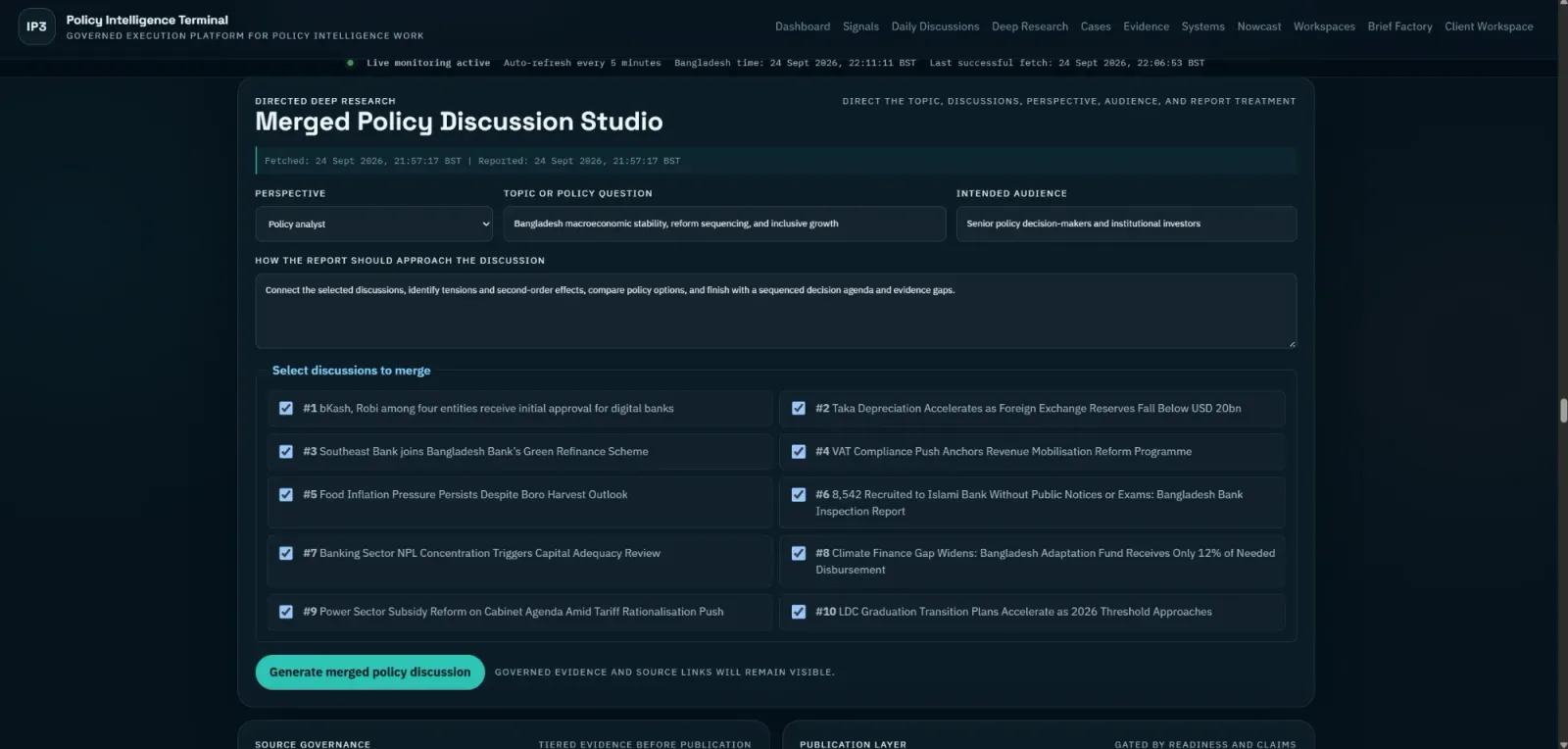
A governed execution platform for policy intelligence work. It watches tiered sources, merges what matters into one policy question, and turns it into briefs that show their evidence before anything is published.

01 / 04

Every signal carries its evidence

Live monitoring refreshes every five minutes. Each story arrives with its sources and their tier, the time it was fetched, and the ranking that put it on the board. Decision lenses re-read the same evidence for an executive, a macroeconomist, a development partner, a market analyst, a political economist or an academic.

  • Tiered, time-stamped sources
  • Transparent ranking explanation
  • Six decision lenses
Signals, sources and decision lenses

02 / 04

Many discussions, one policy question

The Merged Policy Discussion Studio connects the day's discussions into a single piece of directed research. The analyst sets the perspective, the question and the audience, chooses the discussions to merge, and keeps every source link visible.

  • Perspective, topic and audience
  • Tensions and second-order effects
  • A sequenced decision agenda
Merged Policy Discussion Studio

03 / 04

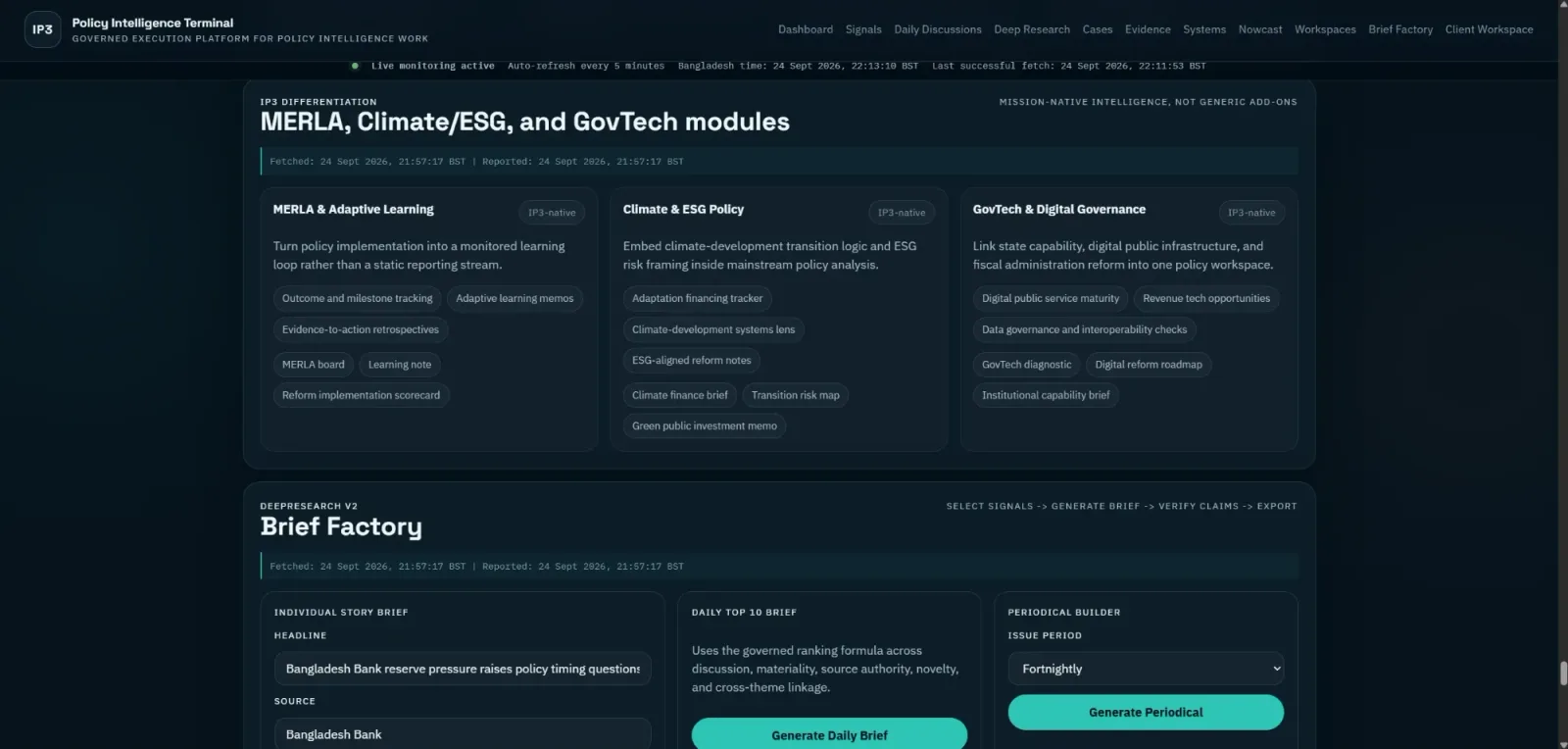
Modules built for IP3's missions

MERLA, climate and ESG, and GovTech are native modules, not add-ons: outcome and milestone tracking with adaptive learning memos, adaptation finance and transition-risk maps, and digital public service maturity with reform roadmaps.

  • MERLA board and scorecards
  • Climate finance and ESG notes
  • GovTech diagnostics and roadmaps
MERLA, Climate/ESG and GovTech modules

04 / 04

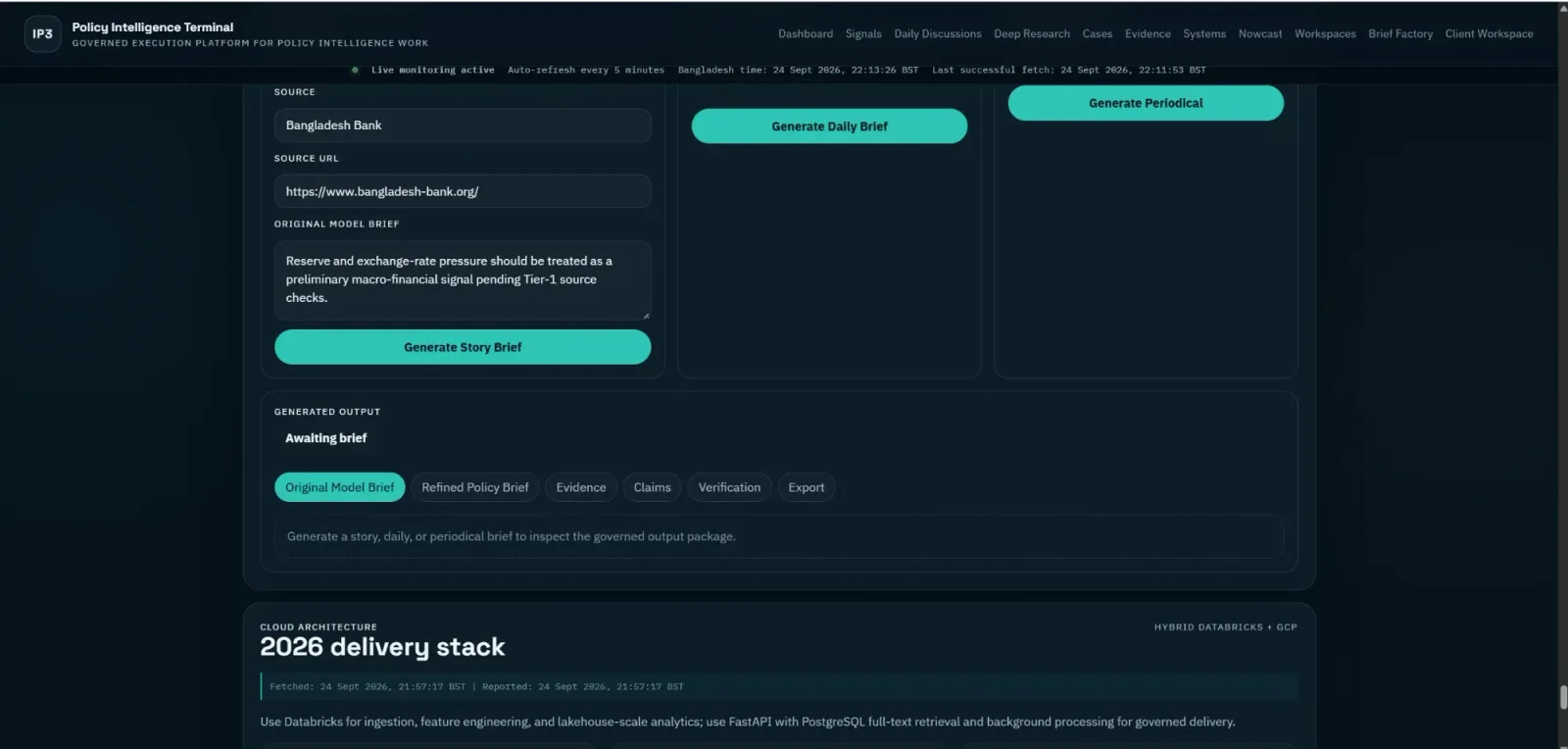
Briefs that show their working

The Brief Factory turns a story, the daily top ten or a fortnightly period into a brief. The original model draft, the refined policy brief, the evidence, each claim and its verification sit side by side before export.

  • Story, daily and periodical briefs
  • Claims checked against evidence
  • Export only after verification
Brief Factory: evidence, claims, verification, export
  1. 00 Signals
  2. 01 Discussions
  3. 02 Deep research
  4. 03 Decision lenses
  5. 04 Brief
  6. 05 Verify and export
How an engagement runs

Six movements, one line.

The full method, with case examples, lives on our approach page.

  1. Sense & Diagnose

    Understand the system before moving to improve.

  2. Build Intelligence

    Turn evidence into decisions, not just reports.

  3. Co-Design & Test

    Turn insight into a credible, testable system.

  4. Mobilise

    A good design means nothing if it isn't resourced.

  5. Implement & Transfer

    Implementation is part of consulting — not what happens after consulting.

  6. Learn & Scale

    Measure to drive change, not justify it.

Read our approach
Start a conversation

Have a difficult policy or development challenge?

Let’s define the question, build the evidence, and identify a practical path forward.

Start the conversation

This form opens a draft in your email app. IP3 receives it only after you press Send there. Your details are used only to reply to your enquiry.